For centuries, music festivals have been about one thing – sound. The pulse of drums, the crash of guitars, the voices of thousands singing in unison. Yet the future of live music may not be heard so much as felt. With advances in immersive technology, neuroscience, and design, the festivals of tomorrow will no longer be limited to what our ears can perceive. They will be total, multi-sensory experiences – environments where rhythm, light, texture, scent, and movement merge to create a new kind of art: one that surrounds the body rather than just reaching the ears.
From Listening to Experiencing
The idea of expanding music beyond hearing is not new. Deaf percussionist Evelyn Glennie once described feeling music through vibrations – a reminder that sound is, at its core, movement through air. Technology is now catching up to this truth. Wearable haptic suits translate bass frequencies into tactile feedback; AI-controlled lighting systems sync with melodies to produce emotion-based visual patterns. Festivals are beginning to move from the auditory into the physical.
At its heart, this evolution transforms music from something you listen to into something you experience. Instead of standing before a stage, the audience becomes surrounded by waves of sensation. Each beat resonates through the skin, each note shifts the color of the lights, each crescendo releases a mist of scent or warmth in the air. The festival becomes less a concert and more an ecosystem of feeling.
The Role of Immersive Design
Immersive environments are already redefining art and performance. From interactive museums to VR exhibitions, creators are experimenting with ways to dissolve the border between audience and artwork. The next step is to apply these ideas to live music.
Imagine entering a festival where each stage is designed not by sound engineers alone but by sensory architects – teams combining musicians, technologists, and neuroscientists. The sound frequencies determine not only what you hear but what you see and touch. Low frequencies might activate floor vibrations that simulate heartbeat-like pulses. Midrange tones could control shifting LED landscapes, while high notes scatter shimmering light particles overhead.
In this scenario, each song becomes a 360-degree sculpture in motion. The dance floor turns into a responsive canvas where the crowd and the technology co-create the atmosphere. The result is music as architecture – something you move through, not just listen to.
Haptics: Touching the Beat
One of the most promising technologies behind this vision is haptic feedback – the science of translating sound into touch. Companies like Woojer and SubPac have already developed wearable devices that let users “feel” bass vibrations through their spine and torso. At festivals, this could mean entire audiences connected through invisible networks of vibration.
Haptic flooring could pulse with rhythm, creating a shared physical heartbeat that unites thousands of bodies in sync. Instead of the ground shaking from amplifiers, it would vibrate with precision, making the collective experience more intimate and controlled. This technology could also make festivals more inclusive for deaf and hard-of-hearing participants, turning sound into a universal physical language.
When combined with biometric sensors, haptics could even respond dynamically to crowd emotion. If collective heart rates rise, the system might amplify warmth and tempo. If the audience slows down, the environment could shift to cooler tones and gentler waves – an intelligent symbiosis between human energy and digital rhythm.
Scent, Temperature, and Emotional Triggers
Music has always had the power to evoke emotion, but scent and temperature can amplify that effect in ways we are only beginning to understand. Studies show that olfactory cues are closely tied to memory and emotion, making scent a powerful storytelling tool. Future festivals might integrate scent diffusion systems that align with musical phases – earthy smells during deep ambient sections, citrus or ozone scents during climactic moments.
Temperature control could work similarly. Cooling air during fast-paced electronic sets could heighten alertness and excitement, while gentle warmth during acoustic performances might evoke comfort and intimacy. The interplay between physical sensation and emotional state could create experiences that feel deeply personal, even in a crowd of thousands.
Visual Synesthesia
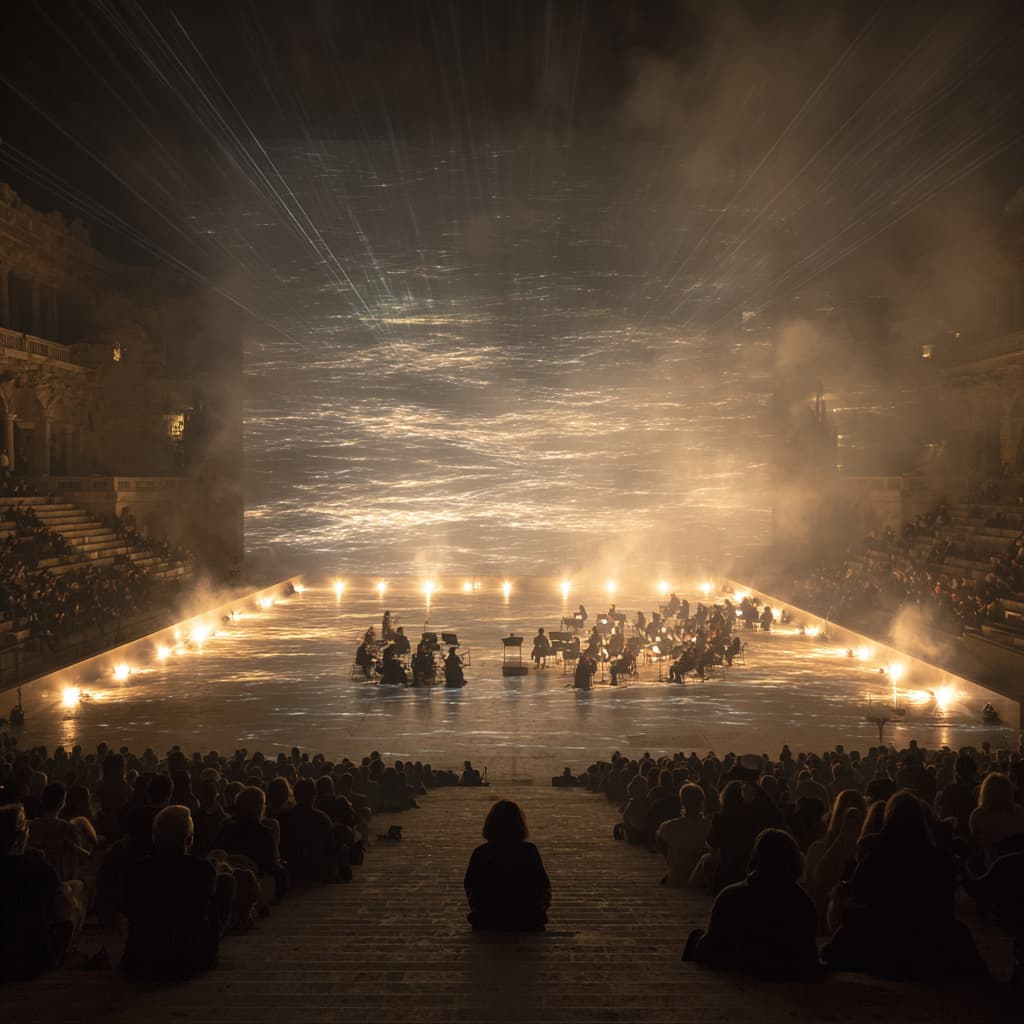
If the ears and skin are the conduits of rhythm, the eyes interpret melody. Visual design already plays a huge role in festivals, from laser shows to projection mapping. But the future will see a shift toward synesthetic synchronization – visuals generated in real time by the sonic structure of the performance.
AI-driven visualizers could translate every note into dynamic imagery. A deep cello tone might manifest as rippling gold, while a singer’s voice paints the sky in violet waves. Augmented reality glasses could allow each attendee to see a unique version of the performance, layering digital art over the physical world. No two experiences would be identical; each participant’s view would be an extension of their sensory and emotional state.
The Ethics of Immersion
As thrilling as this vision sounds, it also raises questions. When festivals begin to manipulate our senses so directly, where is the line between art and control? If scents can alter emotion and haptics can influence mood, how do organizers ensure consent and safety?
The challenge for future festival designers will be to balance immersion with autonomy. Sensory design should empower audiences, not overwhelm them. The goal is not to engineer emotion but to offer new channels for expression – to create a space where technology amplifies humanity rather than replacing it.
Inclusivity and Accessibility
The sensorial festival could also become a more inclusive space. By expanding beyond sound, organizers can create environments that welcome participants with hearing impairments, sensory sensitivities, or physical disabilities. Vibrations, visual patterns, and AR interfaces can turn music into something everyone can perceive in their own way.
This democratization of sensory experience aligns with the broader trend toward accessibility in the arts. Technology, when used thoughtfully, can help bridge gaps rather than widen them.
From Performance to Participation
The sensorial festival redefines what it means to be an audience. When sound becomes touch and sight and scent, the separation between performer and participant blurs. The crowd becomes an instrument – a collective organism responding to and shaping the performance in real time.
This participatory energy may be the most revolutionary aspect of future festivals. We will no longer attend events simply to watch; we will enter them to feel together. Each body in the crowd will contribute data, rhythm, and emotion, feeding back into the performance loop. The line between music and movement will dissolve completely.
The Future of Feeling
The festivals of tomorrow will not be louder, bigger, or faster. They will be deeper. They will move beyond entertainment into something more intimate – an exploration of how technology can connect us to ourselves, to others, and to the physical world through the universal language of sensation.
Music has always lived in the space between vibration and emotion. Now, with the help of science and creativity, that space is expanding into every corner of human perception. The sensorial festival is not just the future of live performance – it is the future of feeling itself.